The Tracker That Disappears Into Your Pocket
Seeed's SenseCAP T1000-E squeezes a GNSS module, LoRa radio, and 700 mAh battery into a credit-card frame — and costs less than a decent meal out.
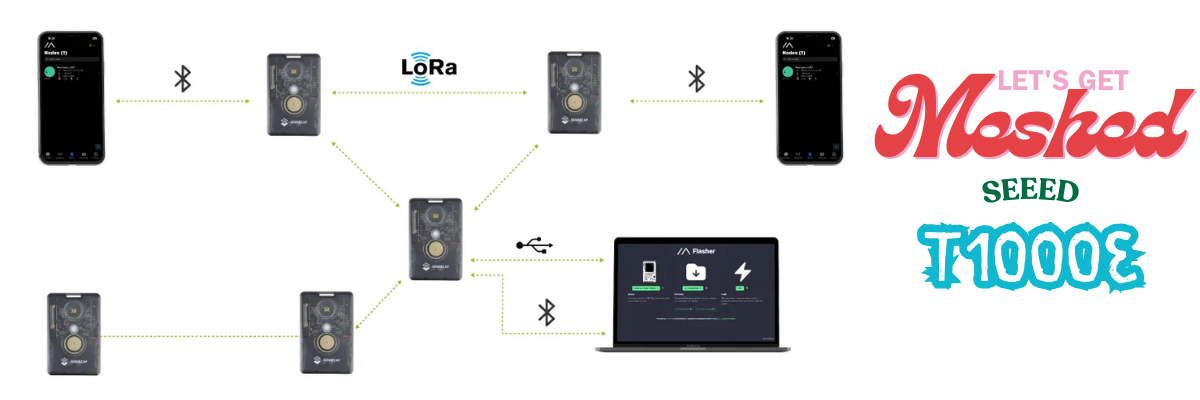
There is a certain satisfaction in hardware that simply works. No IDE needed, no soldering iron on standby, no driver dramas. You take it out of the box, flash the firmware via a web browser, pair it over Bluetooth to the Meshtastic app, and that is that — you are on the mesh. The Seeed SenseCAP T1000-E is that device.
It is, by any honest reckoning, a remarkable amount of hardware for the money. At 85 × 55 × 6.5 mm — exactly the footprint of the card slot in your wallet — it goes anywhere without complaint. Jacket pocket, rucksack hip-belt, dog collar, bicycle frame bag. The form factor is not a gimmick; it genuinely changes where and how you carry a mesh node.
"The T1000-E is the tracker you keep forgetting you're carrying — which is precisely the point."
What is inside the card
The hardware story is genuinely impressive for this price bracket. Seeed have not reached for bargain-bin silicon.
That Mediatek GPS chip deserves a moment. A dedicated GNSS module — not a software-defined approximation, not Wi-Fi triangulation — at this price point is genuinely uncommon. It is the sort of component that makes the overall proposition rather difficult to argue with.
Range and real-world performance
Range is where devices with integrated antennas typically take their lumps, and physics being what it is, the T1000-E is no exception. Without an external antenna, it cannot match a full-size handheld mesh node. That said, field tests have demonstrated reliable contact with base stations elevated over 50 metres, and solid city-block-scale coverage to vehicle nodes. For the use cases the form factor implies — personal tracking, asset tagging, lightweight mesh participation — it is more than adequate.
In urban environments, expect somewhere in the region of one and a half to two kilometres of practical range with obstructions in the way. Out in open countryside, rather more. The key insight is that a T1000-E riding in your rucksack, contributing to the mesh as a relay node whilst simultaneously reporting your position, is doing something no full-size node can manage from a trouser pocket.
The charging compromise
The one polarising design decision is charging. Rather than USB-C, the T1000-E uses a four-pin pogo connector — magnetic, proprietary, and the reason the device can be sealed to IP65. The trade-off is deliberate: the sealed casing is meaningfully more rugged than anything with a port flap, and IP65 means genuine protection from rain and dust. It does, however, mean carrying a dedicated charging puck, which some will find a mild irritant and others will consider a non-issue.
Battery life lands at several days on standby with GPS disabled, or roughly a full day with active location tracking. Use it hard as a repeating node with frequent position broadcasts and you will be charging it each evening — perfectly manageable, but worth knowing before you head out on a multi-day trip.
Getting started
Setup is refreshingly straightforward. Navigate to the Meshtastic Web Flasher, select the T1000-E from the device list, and flash. No IDE, no command line, no drivers. The device ships with firmware pre-installed, so for most users it is simply a matter of pairing over Bluetooth and selecting your region in the app — you will be on the mesh within minutes of unboxing.
The pogo pins also serve as a developer interface: USB, serial logging, and a DFU mode are all accessible there for anyone who wishes to dig into the firmware, or who wants to run it as a LoRaWAN asset tracker rather than a Meshtastic node — a separate firmware variant is available for that purpose.
The SenseCAP T1000-E is stocked in the UK by ML&S Martin Lynch & Sons, the Staines-based amateur radio specialist. As one of the country's leading communications equipment suppliers, ML&S are the natural port of call for UK buyers — no transatlantic shipping, no customs headaches.
Verdict
Strengths
- Genuinely credit-card sized and pocketable
- Dedicated AG3335 GPS — real precision
- IP65 rated — splash and dust resistant
- No-code setup via web flasher
- Supports Meshtastic and MeshCore
- Multi-day standby battery life
- Clip and carabiner attachment included
- Exceptional value for money
Limitations
- Proprietary pogo-pin charging, not USB-C
- No external antenna option
- Range trails larger, external-antenna nodes
- GPS-on battery life is roughly one day
- No display or buttons for standalone use