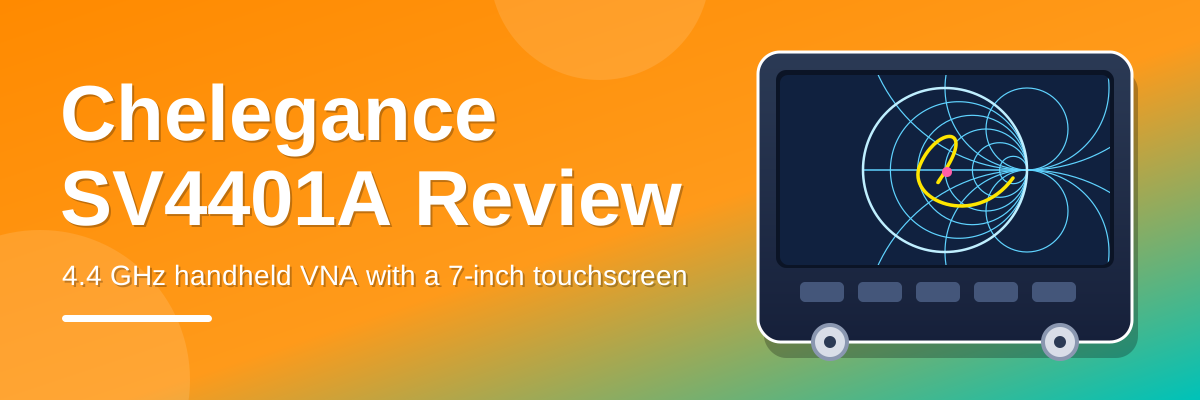
Chelegance SV4401A Review: A 4.4 GHz Handheld VNA With a 7-Inch Touchscreen
The Chelegance SV4401A is a handheld vector network analyser (VNA). It measures from 50 kHz to 4.4 GHz, has a 7-inch touchscreen and two ports, so it can measure both reflection (S11) and transmission (S21). It sits between the pocket-sized NanoVNA type of analyser and the expensive bench instruments.
This review covers what it does, what is in the box, what it costs in the UK, where it is strong and where it is limited, and who it suits. It is based on the manufacturer's published specifications and user manual, the Ham Radio UK listing and the reports I could find from other users. It is not a bench test, so all figures below are the manufacturer's stated figures.
In this review
- Quick summary
- What it does
- S11 and S21 explained
- What you can test with it
- Specifications
- What is in the box
- What it costs
- What it is good at
- Where it falls short
- Protect the input
- Storing the SV4401A
- Your first sweep
- Firmware and quality reports
- SV4401A or a NanoVNA?
- Verdict
- Frequently asked questions
- Sources
Quick summary
| Item | Detail |
|---|---|
| What it is | Two-port handheld vector network analyser |
| Frequency range | 50 kHz to 4.4 GHz |
| Screen | 7-inch IPS capacitive touchscreen, 1024 x 600 |
| Connectors | N-type female, with N to SMA adapters supplied |
| UK price | £329.95 at Ham Radio UK (regular price £349.99) |
| Good for | Antenna tuning, baluns, cable checks, filters and amplifiers, from HF up to 9 cm |
| Less good for | Pocket use, 5 GHz work, anything needing lab-grade accuracy |
What it does
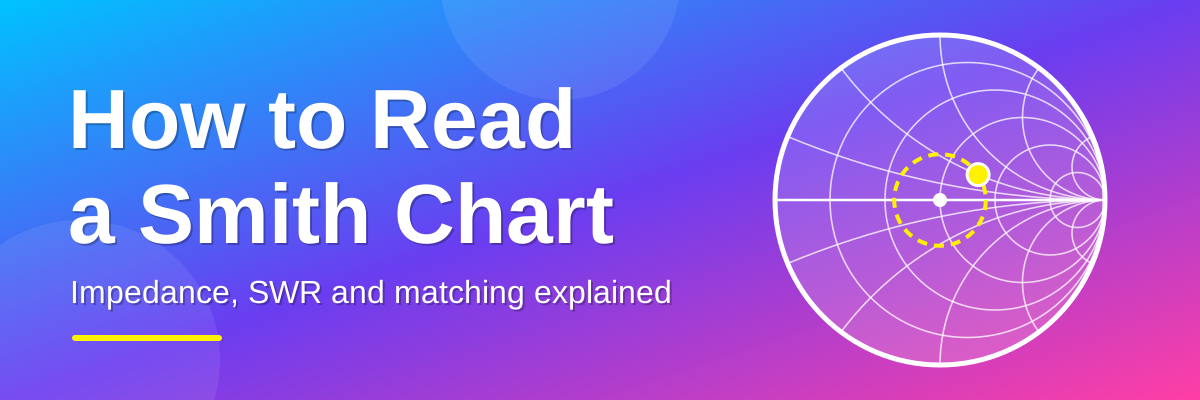
A VNA sends a small test signal into a device and measures what comes back. For an antenna, it tells you the impedance, the SWR and the frequency where the antenna is resonant. The SV4401A shows this in several formats, including a Smith chart, SWR, log magnitude, phase and group delay. If you want to learn to read the Smith chart display, my guide on how to read a Smith chart covers it step by step.
Because it has two ports, you can also measure S21, which is how much signal passes through something. That makes it useful for filters, amplifiers, attenuators and duplexers, as well as antennas. It also has a built-in TDR (time domain reflectometry) function, which can show the length of a cable and the position of a fault.
S11 and S21 explained
You will see S11 and S21 on the analyser's screen and in every VNA review, so here is what they mean. S-parameters describe what happens to a signal when it goes into a device. The two numbers tell you where the signal went in and where it was measured. The first number is the port where it is measured, and the second is the port the signal was sent into.
| Measurement | What the analyser does | What it tells you | Typical uses |
|---|---|---|---|
| S11 (reflection) | Sends a signal out of port 1 and measures how much comes back to port 1 | How well the device matches 50 ohms: return loss, SWR and impedance (shown on the Smith chart) | Antennas, dummy loads, the input of a filter, balun or amplifier |
| S21 (transmission) | Sends a signal out of port 1 and measures how much arrives at port 2 | How much signal passes through the device: loss (insertion loss) or gain | Cables, filters, attenuators, amplifiers, baluns |
The SV4401A measures S11 and S21. To measure the other direction (S12 and S22), turn the device under test around and connect it the other way. A Smith chart is a way of displaying S11. S21 is normally shown as a graph of dB against frequency.

Reading the dB numbers
Both measurements are shown in decibels (dB). For S21, 0 dB means all of the signal passes through. A negative number is a loss, and a positive number is a gain.
| S21 reading | Power that arrives |
|---|---|
| 0 dB | 100% |
| -1 dB | about 79% |
| -3 dB | about 50% |
| -6 dB | about 25% |
| -10 dB | 10% |
| -20 dB | 1% |
| -40 dB | 0.01% |
| -60 dB | 0.0001% |
For S11, the reading is the return loss with a minus sign. The more negative it is, the less signal is reflected and the better the match. A reading of -14 dB is the same thing as an SWR of 1.5:1.
| S11 reading | Equivalent SWR |
|---|---|
| -10 dB | about 1.9:1 |
| -14 dB | about 1.5:1 |
| -20 dB | about 1.2:1 |
| -30 dB | about 1.07:1 |
Before you measure S21
- Calibrate for transmission. The full calibration is OPEN, SHORT, LOAD and then THRU, where port 1 is joined straight to port 2. This sets 0 dB as the reference. The steps are in the first sweep section below.
- Know the noise floor. The stated S21 dynamic range is 75 dB below 3 GHz and 60 dB above. Readings near the bottom of that range are mostly noise, so you cannot measure rejection beyond that. A narrower IF bandwidth (selectable down to 30 Hz) lowers the noise floor, but the sweep takes longer.
- Keep the power low. The input can only take 0 dBm. The analyser's own output is -42 to -12 dBm, which is safe for most parts, but anything that adds gain needs care (see the amplifier example below).
- Do not move the cables after calibrating. Flexing a test cable changes the result, especially at higher frequencies.
What you can test with it
The usual antenna tests
- Find the resonant frequency of a wire, dipole, vertical or loop.
- Check the SWR across a whole band, and see how wide the usable bandwidth is.
- Read the impedance on the Smith chart to see whether the antenna is too long or too short.
- Test a feedline and a matching network or ATU before the transmitter is connected.
- Compare antennas in the same position with the same calibration.
The second port opens up many more jobs. Here are six of them. Each one uses the same idea: put the part between the two ports, and read S21 for what passes through and S11 for how well it matches.
1. Test a balun, unun or matching transformer
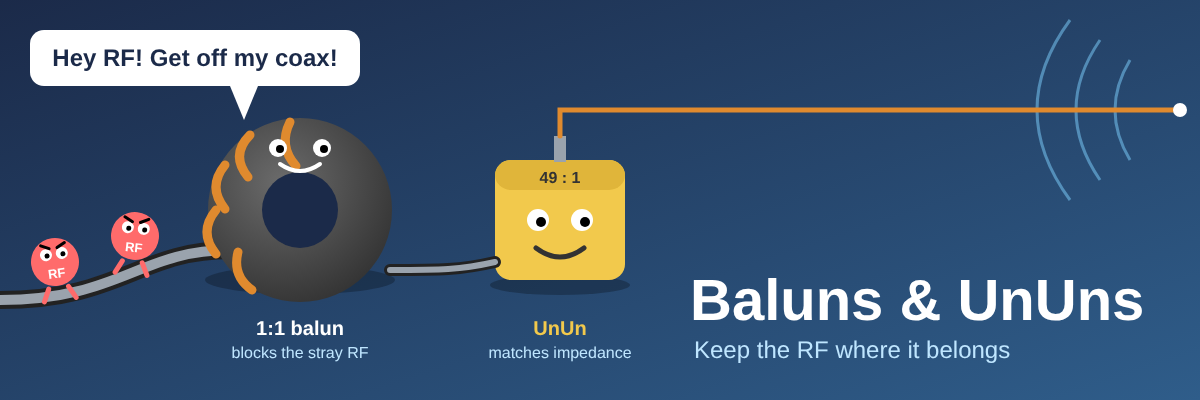
A balun or unun (such as the 49:1 transformer on an end-fed antenna) is hard to judge by eye. There are two simple tests.
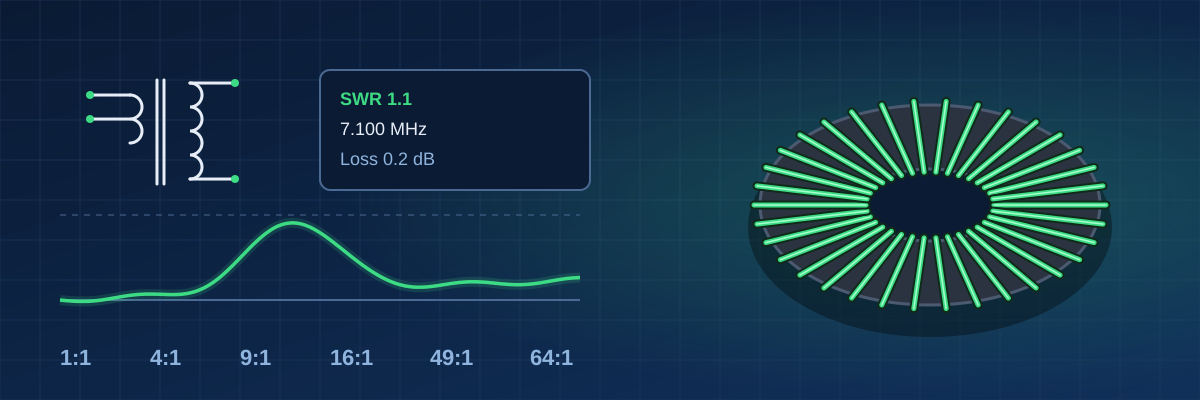
Impedance test (S11). Connect the 50 ohm side to port 1. Put a resistor of the right value on the other side. For a 1:1 balun use 50 ohms. For 4:1 use 200 ohms. For 9:1 use 450 ohms. For 49:1 use about 2450 ohms. Use a low-inductance resistor with short leads, because a long lead adds reactance and spoils the result. A good transformer shows a low SWR across its working band. If the SWR climbs at the low or high end, you have found the limit of its bandwidth.
Loss test (S21). Connect two identical transformers back to back, with their high-impedance sides joined. Connect port 1 to one input and port 2 to the other. The S21 reading is the loss of both. Divide it by two to get the loss of one. Every 1 dB of loss is about 21% of your power turned into heat.
This is a low-power test. It does not show what happens to a ferrite core at high power, where it can saturate or get hot. It is a very good check for build errors and bandwidth.

2. Measure coax loss and find a cable fault
Loss. Connect the cable between port 1 and port 2, using adapters as needed, and read S21 against frequency. Cable loss rises with frequency. Compare the reading with the datasheet for that cable. Much more loss than expected can mean water in the cable, a poor connector or a damaged cable.
Fault location. Connect one end of the cable to port 1 and leave the other end open. Use the built-in TDR function to see the distance to the end of the cable, and to any fault along it, such as a crushed section or a bad join. Enter the velocity factor for your cable first, as a percentage (66 for solid polyethylene coax; check the datasheet for other types). The same method tells you the length of a cable on a drum. The first sweep section below has the steps.

3. Check a filter
Connect the filter between the two ports. S21 shows the loss in the passband and how much signal is rejected outside it. S11 shows how well the filter is matched in the passband. Use markers to read the -3 dB points, which give you the bandwidth.
This works for low-pass filters on an HF amplifier, band-pass filters for a receiver, notch filters for broadcast interference, 70 cm duplexers and 2.4 GHz filters. Remember that rejection deeper than the noise floor cannot be measured, so a very good filter may show a flat line at the bottom of the screen. Narrowing the IF bandwidth helps.

4. Measure the gain of an amplifier or preamp
With an amplifier between the ports, S21 shows a positive number, which is the gain in dB. You can also check how flat the gain is across the band, and how well the input is matched (S11).
Be careful with power. The analyser can only take 0 dBm at its input. Add the amplifier's gain to the analyser's output level to see what arrives. For example, -12 dBm with a 20 dB gain amplifier gives +8 dBm, which is too much. Set the output to its lowest level (-42 dBm), and put an attenuator, such as 20 dB, after the amplifier to be safe. If the amplifier is powered through the coax, use a DC block, because the input must stay below 5 V DC. A low-power test cannot show how an amplifier behaves near its maximum output.

5. Check attenuators, dummy loads and terminators
Attenuators. A 20 dB attenuator should read close to -20 dB on S21 across its working range, and show a low S11 at both ends. A cheap attenuator that drifts, or reflects badly at higher frequencies, will show it straight away.
Dummy loads and terminators. Connect the load to port 1 and read S11 across the band. A good load stays near a perfect match. A poor one rises in SWR as the frequency goes up. This is worth doing on the loads in your calibration kit and on any dummy load that you use for transmitter tests.
6. Test a common-mode choke or ferrite (advanced)
A common-mode choke stops current flowing on the outside of coax. It is the part that keeps the feedline from becoming part of the antenna. You can measure how well it works with a series test.
- Wind the choke as normal and join the centre conductor and the shield together at each end, so that the coax acts as one wire wound on the core.
- Connect that wire in series between the centre pins of port 1 and port 2, with a short link joining the grounds of the two ports.
- Read S21 across the band. The deeper the dip, the higher the impedance of the choke.
- For a rough figure, use impedance in ohms ≈ 100 × (1 ÷ S21 − 1), where S21 is the linear value, not dB.
For example, an S21 of -30 dB is a linear value of 0.0316. That gives 100 × (31.6 − 1), which is about 3000 ohms. Use it to compare chokes, turns counts and core types. It is a guide, not a precision measurement.

Tips for accurate two-port measurements
- Calibrate after you set the frequency range, and again if you change the range or the cables.
- Calibrate with the adapters you will use, so their effect is removed.
- Tighten the connectors the same way each time.
- Keep the test leads and any resistors as short as possible.
- If a result looks wrong, check a known good part first, such as a 20 dB attenuator or a precision 50 ohm load.
Specifications
| Specification | Stated value |
|---|---|
| Frequency range | 50 kHz to 4.4 GHz |
| Frequency accuracy | Better than ±1 ppm below 140 MHz, better than ±5 kHz above 140 MHz |
| Dynamic range, S21 | 75 dB below 3 GHz, 60 dB above 3 GHz |
| Dynamic range, S11 | 50 dB below 3 GHz, 40 dB above 3 GHz |
| Sweep points | 101 to 1001 |
| Sweep speed | 400 points per second above 140 MHz |
| IF bandwidth | 12.5 kHz default, selectable down to 30 Hz |
| Output power | -42 dBm to -12 dBm in 1 dB steps |
| Maximum input power | 0 dBm, and DC below 5 V |
| Traces and markers | 9 traces (4 data, 4 reference, 1 TDR) and 8 markers |
| Calibration | Open, short, load kit included, 18 calibration states stored on the memory card |
| Storage | 8 GB memory card |
| Battery | Two 18650 cells (3.6 V, 3350 mAh each), about 4 hours at 50% brightness |
| Charging | USB Type-C, 5 V / 2 A recommended |
| Size and weight | 190 x 130 x 30 mm, 1.15 kg, metal case |
| Operating temperature | 0 to 45 °C |
What is in the box
- The SV4401A analyser
- Open, short and load calibration kit
- Two N-male to SMA-female adapters
- Two SMA-female to SMA-female connectors and one SMA-male to SMA-male connector
- A 50 cm RG316 cable
- A USB Type-C cable
- A carrying case
Ham Radio UK lists a separate 5.1 V / 3 A USB-C power supply for about £10, and warns that low-power chargers will not work properly with it. The maker also says charging needs a USB-A to USB-C cable, and that a USB-C to USB-C cable may not work. Check this before you buy a charger.
What it costs
The SV4401A is available in the UK from Ham Radio UK.
| Price | Amount |
|---|---|
| Special price | £329.95 |
| Regular price | £349.99 |
These were the prices on the Ham Radio UK listing on 22 October 2026, and it was showing as in stock. Prices and stock change, so check the current listing before you order.
What it is good at
A big screen
The 7-inch touchscreen is the main reason to choose this over a pocket analyser. A Smith chart with several traces and markers is much easier to read at this size. Touch control and physical buttons are both fitted.
Wide frequency coverage
50 kHz to 4.4 GHz covers all the HF bands, 6 m, 2 m, 70 cm, 23 cm, 13 cm and 9 cm, as well as 2.4 GHz Wi-Fi. That is enough for most amateur antenna and filter work. At the bottom end it also covers the low-frequency bands.
Two ports
S21 measurement lets you test filters, preamplifiers, attenuators and cable loss, not just antennas. The stated S21 dynamic range of 75 dB below 3 GHz is good for checking how well a filter rejects unwanted signals.
N-type connectors
N connectors are sturdier than the SMA sockets fitted to most small analysers, and they handle repeated connecting and disconnecting better. Calibration kit and adapters are included, so you can start measuring straight away.
Stored calibrations and a sensible sweep speed
The analyser stores 18 calibration states on its memory card, so you can keep one for each band or cable setup. At the stated 400 points per second, a full 1001-point sweep above 140 MHz takes around 2.5 seconds.
Software and updates
It works with NanoVNA-Saver and the maker's own PC tools. Firmware is updated over USB. The maker lists several firmware versions on its product page, so check there for the latest.
Where it falls short
- It is not pocket-sized. At 1.15 kg and 190 x 130 x 30 mm, it is a lot bigger and heavier than a NanoVNA. It is portable, but you would not slip it in a coat pocket.
- Battery life is about four hours at half brightness. That is fine for a session of antenna tuning with time to recharge, but short for a long portable day. It uses two standard 18650 cells. See the storage section below if you leave it unused for a long time.
- The dynamic range drops at higher frequencies. S11 falls from 50 dB to 40 dB above 3 GHz, and S21 falls from 75 dB to 60 dB.
- The output signal is low. The output is -42 to -12 dBm. That keeps measurements gentle on the device under test, but it is a test signal, not a signal generator.
- It does not reach 5 GHz. 5 GHz Wi-Fi and the 6 cm amateur band are outside its range.
- The temperature range is 0 to 45 °C. Be careful with use in a cold shed or in direct sun in summer.
- It is not a lab instrument. A handheld VNA at this price is great for tuning and troubleshooting, but it is not a substitute for calibrated test equipment where traceable accuracy matters.
- Charging is fussy. You need a suitable 5 V supply and the right cable.
Protect the input
The maximum input is 0 dBm, and the DC level must be below 5 V. That is a very small signal. Never connect the analyser to a live transmitter, and be careful with antennas that can build up static or pick up strong signals from a nearby transmitter. Disconnect the antenna from the radio first, and use a DC block or a discharge step if there is any chance of voltage on the line.
Storing the SV4401A
If you are putting the analyser away for a while, take the two 18650 batteries out first. The battery management system (BMS) in the analyser can slowly discharge them while they are fitted, and over time this can run the cells flat.
If it has already happened, the cells can usually be recovered with a standard 18650 charger. Charge them in the charger, outside the analyser.
- Remove both cells before long-term storage.
- Store them in a cool, dry place, away from metal objects that could short the terminals. A small plastic battery case is ideal.
- Check them every few months and top them up if they have dropped a lot.
- Do not charge a cell that is swollen, damaged, leaking or hot. Replace it.
Your first sweep: from unboxing to a calibrated antenna reading
This walkthrough takes you from a new analyser to a calibrated antenna reading. It follows the maker's user manual (version 4.0, for firmware 0.7.3), and the example is a 40 m dipole. Menu names can change in later firmware, so if something looks different, check the manual that matches your firmware.
Step 1: Charge it and switch it on
Charge the analyser through the USB Type-C port. The manual recommends a 5 V / 2 A charger, and the maker advises using a USB-A to USB-C cable. Switch it on with the power switch on the side. The battery voltage, level and charging status are shown in the battery area of the main screen.
Step 2: Set the frequency range
Set the range before you calibrate, as the manual advises. Touch the start and stop frequencies on the main screen, or go to STIMULUS → SET FREQUENCY and choose start/stop or centre/span. For a 40 m dipole, use 6.8 MHz to 7.4 MHz.
Then set the number of sweep points by touching the sweep-points area, or go to STIMULUS → SWEEP POINTS. The range is 101 to 1001. More points show more detail but take longer to sweep.
Step 3: Fit the cable and adapters
The supplied calibration kit has SMA open, short and load pieces, and the analyser has N-type sockets, so you need the N to SMA adapters. Fit the test cable, and any adapter you will use to reach your antenna (for example one for a PL259 / SO-239 socket), on port 1. You will calibrate at the end of this cable, so the cable and adapters are removed from the measurement.
Step 4: Calibrate
- Touch CAL → CALIBRATE.
- Connect the OPEN piece to the end of the cable at port 1 and touch OPEN. A check mark appears on the menu item.
- Connect the SHORT piece and touch SHORT.
- Connect the LOAD piece and touch LOAD.
- If you will measure S21 (filters, baluns, cable loss), connect port 1 and port 2 together with a cable and touch THRU. The manual lists this as part of the full calibration.
- Touch DONE. The text "OSLT #*" appears. This means the calibration has been made but not yet saved.
Step 5: Save the calibration
Touch SAVE n to store it in one of the numbered slots, or SAVE FILE to save it as a named file. To load it again later, go to SAVE/RECALL → RECALL → RECALL n (or RECALL FILE). Keep one calibration for each band or cable set-up that you use often. CAL → RESET clears the calibration in memory only, and your saved ones stay on the memory card.
Step 6: Check that the calibration is good
The manual gives a simple check. If any of these look wrong, repeat the calibration.
| Connect to port 1 | What the Smith chart trace should show |
|---|---|
| Nothing (open) | A point at the far right of the chart |
| The short piece | A point at the far left of the chart |
| The 50 ohm load | A point at the centre of the chart |
| Port 1 joined directly to port 2 (S21) | A log magnitude trace near 0 dB |
Step 7: Choose what to display
Long-press one of the trace control boxes on the right of the screen to open its settings. Set the format, for example Smith R+jX, VSWR or Log Mag, and adjust the scale and reference position in the same menu. Touch a trace box to turn that trace on or off. A good starting point for antenna work is one trace on the Smith chart and one on VSWR.
Step 8: Connect the antenna and place a marker
Connect the antenna. For a dipole, fit a choke at the feedpoint so the outside of the coax does not affect the reading. Then go to MARKER → SELECT MARKER and touch MARKER 1 to turn it on. Drag it along the trace, or touch the frequency in the marker table, to put it at 7.1 MHz. To find the best match automatically, go to MARKER → SEARCH, choose the trace, set MIN on the VSWR trace, and turn TRACKING on.
Step 9: Read the result and adjust
- A trace that crosses the horizontal line to the left of 7.1 MHz means the antenna is resonant below your target, so it is too long. Shorten it a little.
- A trace that crosses to the right of 7.1 MHz means it is too short. Lengthen it a little.
- The nearer the trace passes to the centre of the Smith chart, the better the match at that frequency.
- Make small changes, sweep again, and keep going until the resonant point sits where you want it.
If the Smith chart readings are new to you, see my guide on how to read a Smith chart.
Bonus: check a cable with TDR
- Connect the cable to port 1 and leave the far end open or shorted.
- Touch the TDR control box to turn it on. A brown trace appears. TDR works on S11 only.
- Long-press the TDR box and enter the velocity factor as a percentage, for example 66 for solid polyethylene coax.
- Touch Peak Search, or move a marker to the highest peak. The estimated cable length appears on the screen. Smaller peaks along the way point to faults.
For short cables, reduce the number of sweep points. The manual gives an example: with a 3 GHz span, 501 points reaches about 17.5 m and 101 points reaches about 3.5 m.
Firmware and quality reports
This analyser is also sold under the Sysjoint and JNCRADIO names. In 2022 one user on a NanoVNA forum reported that firmware 0.3.0 broke the S21 charts after calibration on his unit. His workaround was to calibrate on the older firmware and then load the saved calibration. The maker lists newer firmware versions now, and I found no recent reports of the same fault, but it is a good reason to read the release notes before you update and to keep a backup of your calibration files.
Independent measured reviews of this model are limited. There is a video overview by W2AEW that covers the features and the menu layout. If accuracy matters for your work, check a known load, such as a precision 50 ohm terminator, before you trust any reading.
SV4401A or a NanoVNA?
| Choose the SV4401A if | Choose a NanoVNA type if |
|---|---|
| You want a large, easy-to-read screen | You want something small enough for a pocket or go-bag |
| You test filters and amplifiers as well as antennas | You mainly check antennas and cables |
| You use microwave bands up to 4.4 GHz | You only work on HF and VHF |
| You use N-type connectors and want them built in | You want to spend as little as possible |
Verdict
The Chelegance SV4401A is a practical step up for anyone who has outgrown a pocket NanoVNA. The big touchscreen, two ports, N connectors and 4.4 GHz range make it a good all-round bench and field analyser for an amateur radio shack, at about £330 from Ham Radio UK. The trade-offs are size, weight, a four-hour battery and limited independent test data.
If you mainly tune HF and VHF antennas and want something light, a smaller analyser will do the job for less money. If you want to see the Smith chart clearly, check filters and cables, and work up into the microwave bands, this is a strong choice.
Frequently asked questions
What is the SV4401A?
A handheld two-port vector network analyser from Chelegance that measures from 50 kHz to 4.4 GHz.
Is it the same as the Sysjoint SV4401A?
The same model is sold under the Sysjoint, Chelegance and JNCRADIO names.
Can it measure SWR?
Yes. SWR is one of the display formats, alongside the Smith chart, log magnitude, phase and group delay.
Can I use it with a PC?
Yes. It works with NanoVNA-Saver and the maker's own PC software over USB.
Can I test a filter with it?
Yes. The second port allows S21 measurements, which show how a filter passes and rejects signals.
Can I connect it to my transmitter?
No. The maximum input is 0 dBm, so a transmitter would damage it. Always disconnect the antenna from the radio before measuring.
How long does the battery last?
The maker states about four hours at 50% screen brightness.
What is S21?
S21 is the signal that passes through a device from port 1 to port 2. It shows loss for things like cables and filters, and gain for amplifiers.
What is the difference between S11 and S21?
S11 is the signal reflected back from a device and tells you how well it matches. S21 is the signal that passes through and tells you the loss or gain.
Can I test a balun with it?
Yes. Test the impedance transformation with a resistor on the output, and test the loss by connecting two identical baluns back to back and reading S21.
How should I store it?
Take the two 18650 batteries out. The BMS can slowly discharge them while they are fitted, and they can go flat. If that happens, they can usually be recovered with a standard 18650 charger.
Sources
- Chelegance SV4401A product page (specifications, accessories, firmware)
- SV4401A user manual V4.0 (for firmware 0.7.3: menus, calibration, markers, TDR)
- Ham Radio UK SV4401A listing (UK price and box contents)
- W2AEW video #402: Overview of the Sysjoint SV4401A
- NanoRFE forum: SV4401A 0.3.0 firmware problem